

Should I Draw Town Map Dnd 5e
Are you looking for the best solution to create DnD maps? Look no further! In this commodity, we cover the best DnD map makers and their pros, cons, and utilise cases.
Arcane Eye may earn a minor commission from affiliate links in this article. Learn more.
The two types of D&D maps
Because it is a tabletop game, nearly of the visualization in D&D is left up to the imagination. Some groups may rely on the DM's descriptions of the locations they find themselves in, while other groups use maps. Whether you play in-person or online and with or without battlemaps, chances are you will be creating a map for something while playing D&D.
There are two principal types of maps used commonly in D&D: regional maps and battlemaps.
Regional Maps
These maps are typically on a larger scale than battlemaps. They show the region from a bird's-eye view. These maps can exist anything from a world map, provincial map, or urban center map.
If used for exploration, and then these maps can incorporate a filigree. This type of exploration is typically called a "hex crawl" and is addressed in depth in the D&D Adventure Tomb of Anything.
Battlemaps
These maps are usually on a smaller scale than regional maps. Typically, they are self-independent for a single come across, though they can grow to display the entirety of a dungeon or building that players are working their fashion through.
Battlemaps are commonly overlaid past a standard five-human foot past 5-pes filigree to make histrion movement and scaling consistent.
How to brand D&D maps
There are two primary ways to make maps; they can exist manus-fatigued or fabricated using online software. Mitt-drawn maps take been effectually since the inception of D&D. These maps, near commonly used for in-person games, tin be combined with terrain pieces or miniatures.
Hand-drawn maps can be drawn on annihilation from a slice of printer newspaper to whiteboards, but in recent years, wet-erase grid maps have become thecrème de la crème solution.
Mapmaking software, due to the sheer number of options, is a much less straightforward solution. In that location are plenty of ways to use digital maps, y'all could impress them off or use a communal screen for in-person sessions, or use them with virtual tabletops for online sessions. In this article, we will explore which software is best for which purposes while making D&D maps.
The Best DnD Map Making Software
There will never exist a straight-up "all-time" D&D map maker. The below-featured map makers will list the pros and cons of each software, too every bit their all-time apply case.
Inkarnate
Inkarnate is easily the best fantasy map making software on the market. It'southward got a slick UI, tons of avails, and tin can create detailed maps in a matter of minutes.

Pros
- Easily the most fleshed out, versatile map building choice
- Completely online, no software download or install
- UI is thorough enough to create amazing maps but streamlined enough to build maps quickly
- Costless and Pro versions
- Can import custom assets
- Pro version allows for commercial sale of maps
Cons
- Walls don't "snap" together, which tin can make the cosmos of dungeons or other indoors areas clunky
- Subscription model, non a 1 fourth dimension purchase
- UI can become slow on big maps with lots of assets or slow cyberspace connection
Use Case
Inkarnate can be used to create regional maps and battlemaps. I take constitute myself reaching for Inkarnate most of the time I am creating a straightforward battlemap. Because I try to keep my session prep to under two hours, it'due south extremely prissy to be able to punch out a detailed map in five to ten minutes.
Inkarnate'south regional map maker is also a bang-up tool, though I tend to employ it much less ofttimes.
I do have to say that creating a map with lots of rooms, such as a dungeon or large building, is a bit of a grind with Inkarnate only due to the level of detail they require.
All in all, I would compare Inkarnate to a "map-focused Photoshop". The layering, blending, and usage of assets has a similar experience to the infamous image editing software and while it might not exist the most streamlined D&D map-making software, it is a bully mix of easy to employ and customizable.
Check out the free or pro version at inkarnate.com
Wonderdraft
Wonderdraft is a fantasy map-making software that focuses specifically on regional maps.

Pros
- Regional map-making tools are unrivaled
- One time buy
Cons
- Software download, no in-browser option
- While battlemaps can be created using the software, it is certainly not meant for this application
- No free option
Use Example
Wonderdraft is unrivaled in its ability to create regional maps. While Inkarnate is a shut second, the once purchase, huge array of assets, and streamlined UI make this the best solution for larger-calibration maps.
Buy Wonderdraft for $29.99 at wonderdraft.net
Dungeondraft
From the aforementioned creator equally Wonderdraft, Dungeondraft focuses specifically on smaller-scale battlemaps.

Pros
- The vector-based system can scale to any resolution
- Walls and floors are seamlessly integrated, making the cosmos of complex indoor environments a cakewalk
- Custom assets, brushes, etc. are easily bachelor
- No internet required to use
- Born lighting system
- One time buy
- No additional commercial licensing
Cons
- Software download, no in-browser option
- While regional maps can be created using the software, it is certainly non meant for this application
- No gratuitous option
- From personal experience, can crash unexpectedly on the M1 Macbook Air
- Fewer assets than Inkarnate
Use Case
Dungeondraft has been my go-to battlemap creator recently, especially when doing an interior scene such as a dungeon, cavern, or fortress. In my opinion, Dungeondraft's Building Tool is the quickest and most effective way to create indoor battlemaps out of whatsoever D&D map-making software available on the market.
Buy Dungeondraft for $29.99 at https://dungeondraft.net/
Dungeon Scrawl
Dungeon Scrawl is an online map architect designed to create unproblematic maps with a manus-fatigued feel.

Pros
- Import from donjon Random Dungeon generator
- The UI is very make clean and easy to utilize
- The simplified purpose of the tool allows the cosmos of complex buildings or intricate tunnels very chop-chop
- Free to use
- Tons of unlimited pixel exportable options that tin integrate with Photoshop or Illustrator to further populate maps
- Avails by 2 Minute Tabletop (for not-commercial use only)
Cons
- Maps cannot mimic real-globe textures like Inkarnate or Dungeon Fog
- Battlemaps only, no regional map options
Employ Instance
Dungeon Scrawl is meant to practise one thing actually well, create intricate dungeons. Whether you are creating a large building with multiple rooms and floors, or a cavern that twists and turns nether the ground, Dungeon Scrawl is the best option to create them speedily and effectively.
If you would similar your dungeon to be populated with intricate features, Inkarnate is a improve bet but it volition take much longer to produce a quality event.
You lot tin can cheque out Dungeon Scrawl for gratuitous at probabletrain.crawling.io/dungeon-scrawl. If y'all like it, please back up the developers 🙂
Dungeon Fog
Dungeon Fog is like to Inkarnate. It is an online architect that has tons of assets and textures with a freemium model.

Pros
- Can organize maps into groups or "floors" likewise every bit into campaigns
- Door and windows snap to walls allowing for easier cosmos of multiple rooms
- Better organization of avails than Inkarnate
- Can be used to brand regional maps and battlemaps
Cons
- Much more than expensive than Inkarnate
- Less gratuitous assets than Inkarnate
- UI isn't very easy to navigate
- Very hard to find which assets can exist used for gratuitous users
Use Case
Dungeon Fog is a competitor with Inkarnate, but in my opinion, it is more expensive with a less user-friendly interface and limited functionality.
The biggest reward Dungeon Fog has over Inkarnate is the ability to quickly make dungeons or large buildings with interconnecting rooms.
For a full review of the software check out our Dungeon Fog Review. You lot can bank check out Dungeon Fog at dungeonfog.com and go ten% off using the coupon code ARCANEEYE.
Dungeon Builder past Hobbyte
Hobbyte is a downloadable map builder that focuses on isometric (3D) dungeons.

Pros
- Extremely unique and cool way of displaying maps
- Commercial options available
- Can make pocket-sized regional maps and dungeon maps
- Easy to mod assets
- Y'all tin curl die, open up doors, reveal traps, and gradually present your maps manually or using their fog of war feature. This is of import because these maps would be extremely hard to utilize in a typical online platform similar Roll20 and Fantasy Grounds.
- Scalable exporting to fit whatever resolution
Cons
- The free version is more than of a demo than a feasible map maker
- Commercial licenses are much more expensive than Inkarnate
- Maps tin be confusing to await at
- No online solution
Employ Case
Hobbyte is the best option for isometric D&D maps. Not everybody will be looking for a solution to brand isometric maps, but if you are this is the best pick.
Yous tin bank check out the costless verion of Hobbyte here and purchase the Dungeon Builder and commercial licenses here.
RPG Map Editor 2
RPG Map Editor 2 is an online and downloadable D&D map maker that focuses on pixel-style maps.

Pros
- The best affair about this tool, in my opinion, is its integration with the Watabou Ane Page Dungeons tool and the donjon Random Dungeon Generator. Both of these tools are stellar starts to creating a dungeon, and beingness able to manipulate them with RPG Map Editor 2 really brings it home.
- Completely gratuitous (fifty-fifty commercial use)
- Cool, pixel-style artful
- Maps tin can be exported to upload to Roll20 or other virtual tabletops
Cons
- There aren't a ton of assets or textures simply y'all tin can custom import icons
- Focuses mainly on dungeons, rather than other types of maps
Use Case
RPG Map Editor 2 is a great tool for creating simpler dungeons. I apply it when I desire to pre-generate the dungeon using Watabou or donjon and and so make edits to the layout with RPG Map Editor.
Y'all can RPG Map Editor 2 for free here. If you savor using it, please back up the devs 🙂
Profantasy'due south Campaign Cartographer 3
CC3 is easily the most intensive (and expensive) map-making software available on the market place.
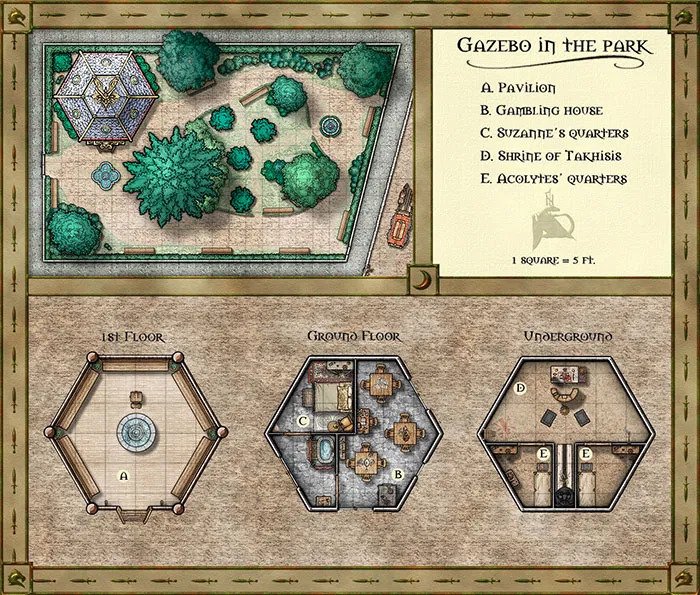
Pros
- Extremely powerful, vector-based, CAD software
- Frequently featured on HumbleBundle to make the big price tag more than palatable
- Add ons tin permit for making all kinds of maps from big-scale regional maps down to small-scale, single building maps
- Tons of asset packs available for download that tin can customize the way your maps look and feel. Plus, some nugget packs are by Mike Schley, a professional map maker who has fabricated maps for many official D&D modules
Cons
- Gaining access to the unabridged suite of map-making tools tin cost $1245 USD when non on sale
- Because the functionality is so extensive, at that place is a very steep learning curve
Use Case
Campaign Cartographer 3 is for hardcore map builders. If you lot want to invest time and money into becoming a professional or semi-professional person map builder, CC3 is for you lot. If you are a DM who is looking for quick and piece of cake software to brand maps for their sessions, I would strongly consider looking at other options.
Decision
In that location you have it! We've looked at the best D&D map makers, their pros, their cons, and the use case for each.
Practice you have a favorite way to make D&D maps that weren't mentioned here? Allow us know in the comments below!


Source: https://arcaneeye.com/dm-tools-5e/dnd-map-makers/
Posted by: hickstherinchis.blogspot.com
0 Response to "Should I Draw Town Map Dnd 5e"
Post a Comment